The plan
– Look after the remnant rainforest.
– See how many native bush foods we could grow.
– See how many other fruit and vegetables we could grow and eat.
– Avoid using gas and petrol and chemicals where possible.
What actually happened
We moved into a vacant block, with the top third grass, the middle third camphor, and the bottom third remnant rainforest. There was the odd dumped car, and even a kitchen sink and clothes line from the house that had been there 15 years ago.
There was a LOT of lantana, tobacco plant, moth vine, blue billygoat weed, the odd giant devil’s fig, which we manually weeded and burnt for the first few months. We started with small tools, and then discovered the pleasure of good tools.
We weren’t sure what to do about the camphor, and had read about various methods, including injection, removal etc.
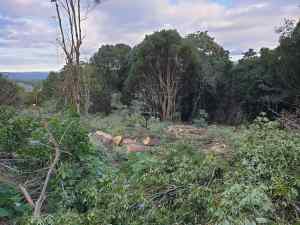
There was one smallish area at the south end that really was pure weed – just camphor and lantana, so we got a local tree guy in to cut down the camphors and treat the stumps. This was our first mistake. Funds were limited and we had the choice of removing and mulching 4 trees, or removing 8 trees and leaving to decay (or for us to chop). We chose to remove 8 trees, which really was too large an area for us to maintain. It was hard working around fallen trees, and the weeds grew back.
We borrowed goats for a while, which worked really well, but again the weeds grew back.
We found another arborist named Ben (blts.com.au) with a log grabber and mulcher who consolidated the fallen logs into burn piles, mulched what he could, and made things a bit more easier to work, working in between the good plants.
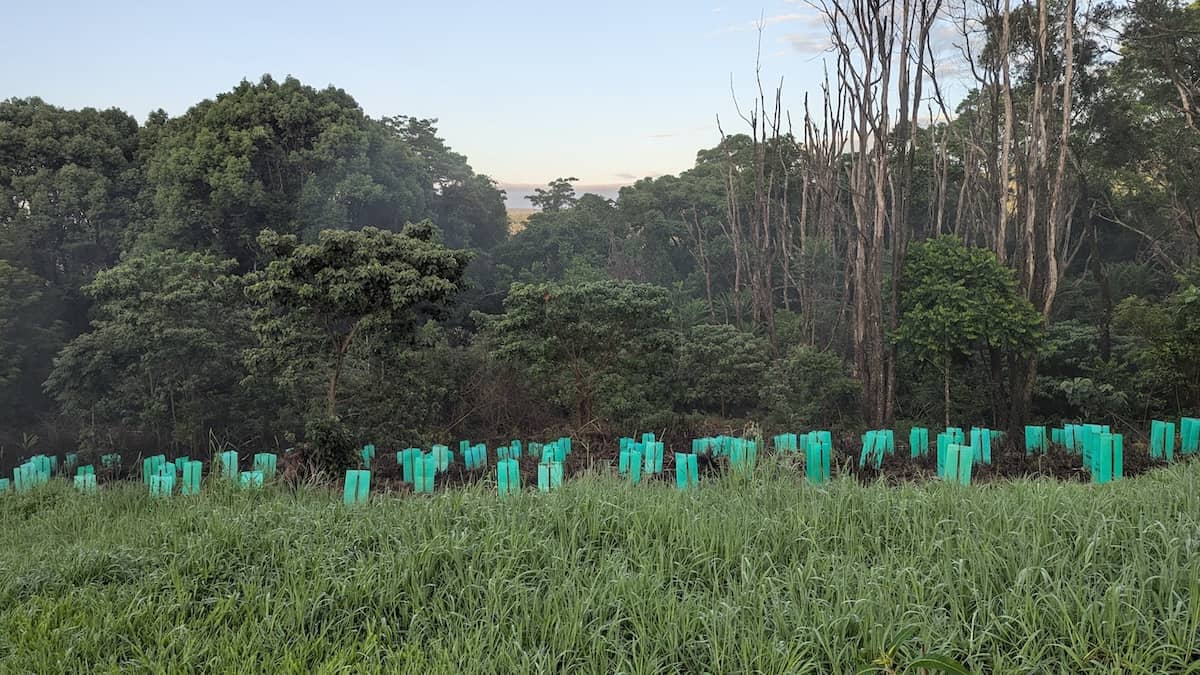
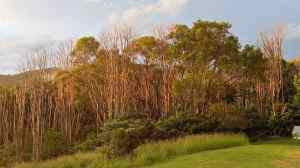
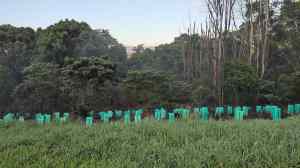
We worked with Stuart and Simon from Northern Rivers Ecological for a number of years now. There was the initial Bush Connect grant work at the north end starting 2020, which is now really well established.
We then extended it a bit, towards the middle of the property two years ago, and then extended it again in 2024. There’s one more piece at the south that we still need to work on, but that’s the main thing we’ve learnt – not to bite off too much at a time.
We did get Ben back again to cut the tops off some of the poisoned camphors, purely for safety reasons, as they were close to where we were working and planting. But all other work and regen plantings have been with Stuart and Simon at http://www.northernriversecological.com/
As a novice, it’s been interesting to see how often follow-up treatment is required, to keep the grass and weeds under control, feed the new plants and thin back overgrowth.
For the bush foods, we’ve had success with lemon myrtle, cinnamon myrtle, anise myrtle, lemon aspen, plum pine, macadamia, lilly pilly, pig face, midgen berry, native currant, native thyme. For other fruit and vegetables we’ve planted lemon, lime, apple, peach, plum, mango, avocado.
Photos
Things I learnt
– Stuff grows really really quickly in the Northern Rivers.
– Weeds will grow faster than you can weed them.
– Feb/Mar you can almost see the trees grow.
– Goats don’t like goat weed.
– Goats like almost everything else, so make sure their fence is strong.
– Just because a local nursery stocks it, doesn’t mean it’s not a weed that can invade a rainforest. Check everything before you buy it.
– Tree guards are good while trees are growing – again pademelons, goats etc.
– You will need nets for fruit trees – to protect against bats, and birds.
– There are actually a lot of awesome resources online – you just need to find them.
Things I’d do differently
– Get advice up front – about weeds, weed control, camphor control. The old-timers know what works.
– Work on smaller areas until they’re under control.
– Although it won’t ever really be under control – stuff grows too fast.
– Get good tools (I love my battery EGO brushcutter), hand garden fork, garden shears, lopper. Carl loves his electric ride-on mower.
 Goonengerry Landcare